Déjà Vu: Have You Lived This Moment Before? The Science Behind This Mysterious Feeling
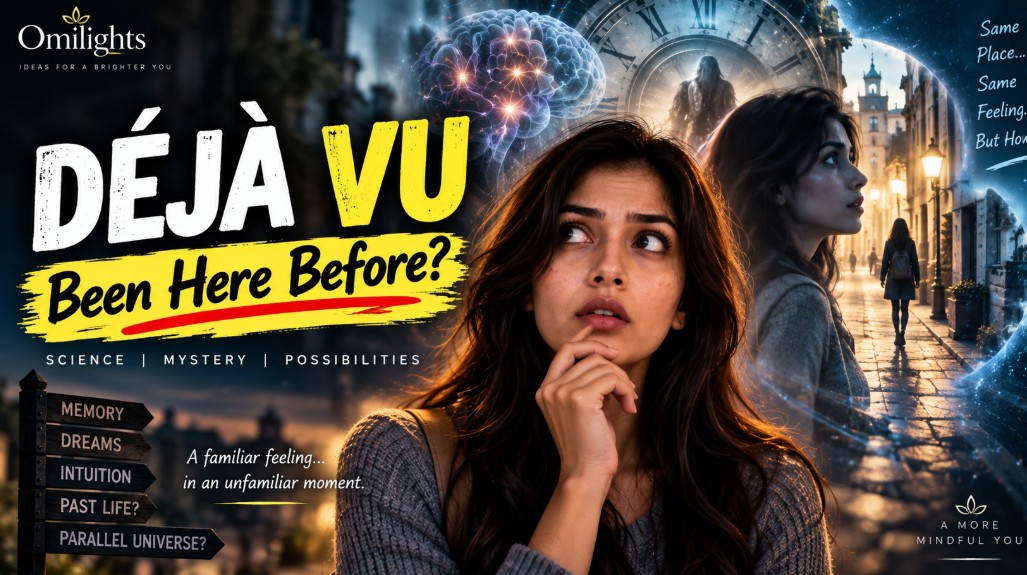
Have you ever walked into a completely new place and suddenly thought:
“Wait… I’ve been here before.”
You look around. The room feels familiar. The people seem familiar. Even the conversation feels strangely predictable.
For a few seconds, you may feel as if you already know what is going to happen next.
But there is one problem.
You know you have never experienced this exact moment before.
So why does it feel so familiar?
This strange and fascinating sensation is known as déjà vu.
It may last only a few seconds, but it can leave you wondering for hours.
Was it simply a trick of memory?
Did you see this moment in a dream?
Could it be intuition?
Or is there something more mysterious happening inside the human brain?
Let’s explore what déjà vu really means, why it happens, and what science says about some of the fascinating theories surrounding it.
What Does Déjà Vu Mean?
The term “déjà vu” comes from French and literally means “already seen.”
It describes the unusual sensation that something happening right now has somehow happened before, even though you know that the situation is new.
Imagine visiting a city for the first time.
You turn into a narrow street, notice a small café on the corner and suddenly stop.
Something feels strange.
You think:
“I know this place.”
But logically, that makes no sense. You have never visited that city before.
That conflict between what you know and what you feel is what makes déjà vu so intriguing.
Your logical mind says:
“This is new.”
But another part of your brain seems to whisper:
“No. You have experienced this before.”
Why Does Déjà Vu Happen?
There is no single explanation that conclusively accounts for every déjà vu experience.
However, researchers have studied déjà vu in relation to memory, familiarity and the way our brains process experiences.
Several possible explanations help us understand why a completely new moment can sometimes feel strangely familiar.
1. Your Brain May Recognize Something Without Knowing Why
Our brains do not necessarily remember experiences as perfect video recordings.
Instead, memories can involve many different elements:
- Places
- Sounds
- Smells
- Faces
- Emotions
- Shapes
- Spatial layouts
- Patterns
Now imagine entering a restaurant you have never visited before.
The restaurant itself is new, but perhaps its layout resembles a restaurant you visited years ago.
Maybe the lighting is similar.
Perhaps the entrance, furniture or smell reminds your brain of another place.
You may not consciously remember the original experience, but something about the new environment can still produce a strong feeling of familiarity.
Suddenly, you think:
“I’ve been here before.”
The location may be completely new.
The feeling of familiarity, however, is very real.
2. Familiarity Is Not the Same as Remembering
Have you ever looked at someone’s face and thought:
“I know this person from somewhere…”
But no matter how hard you try, you cannot remember where you have seen them?
This demonstrates an interesting distinction between familiarity and recollection.
Something can feel familiar even when we cannot consciously identify the source of that familiarity.
Déjà vu may sometimes involve a similar mismatch.
Your brain produces a powerful sense of recognition, but you cannot retrieve the memory that supposedly explains it.
That leaves you with an uncomfortable question:
“If I remember this, why can’t I remember when it happened?”
And that is when an ordinary moment can suddenly feel mysterious.
3. Did You See the Moment in a Dream?
This is one of the most fascinating experiences people associate with déjà vu.
Some people say:
“I’m sure I saw this exact moment in a dream.”
Could dreams be connected to déjà vu?
We dream frequently, but much of what we dream is forgotten soon after waking.
Sometimes only fragments remain — a place, a face, an emotion or a particular atmosphere.
It is therefore possible that a real-life situation could resemble elements of a forgotten dream and trigger a sense of familiarity.
But there is an important distinction.
Feeling that you dreamed about an event beforehand is not scientific evidence that dreams can reliably predict future events.
The experience can feel incredibly convincing without proving that the future was actually seen in advance.
4. Déjà Vu and Intuition: Do We Know What Will Happen Next?
Here is where déjà vu becomes even more interesting.
Sometimes during déjà vu, people don’t simply feel that the present moment has happened before.
They feel as though they know what is about to happen next.
Someone is talking and you suddenly think:
“I know exactly what they are going to say.”
Then they say something similar.
Now the experience feels almost supernatural.
But our brains are extraordinarily good at recognizing patterns and making predictions.
During a conversation, for example, your brain is constantly processing context, facial expressions, previous sentences, tone of voice and past experiences.
It can form expectations about what is likely to happen next without you consciously realizing it.
Therefore, a strong feeling of prediction is not necessarily proof that you have seen the future.
5. Is Déjà Vu Connected to a Past Life?
One of the most popular spiritual interpretations of déjà vu connects it with past lives.
Imagine visiting an ancient building for the first time and experiencing an overwhelming feeling that you somehow know the place.
Some people might wonder:
“Could I have been here in another life?”
It is certainly a fascinating idea, and beliefs about reincarnation exist in various spiritual and philosophical traditions.
However, from a scientific perspective, déjà vu is not considered reliable evidence of memories from a previous life.
This distinction is important.
A spiritual interpretation may view déjà vu as a connection with another lifetime.
A scientific investigation generally looks at memory, familiarity and brain processes for explanations.
Personal beliefs may differ, but extraordinary scientific claims require evidence that can be independently tested.
6. What About the Parallel Universe Theory?
Another popular explanation circulating online is even more mysterious:
What if déjà vu happens when two parallel realities somehow overlap?
Imagine another version of you living a slightly different life in another universe.
Perhaps that version of you has already experienced the moment you are experiencing now.
For one brief second, the two realities appear to connect.
It sounds fascinating — and it would make an excellent science-fiction movie.
But there is currently no established scientific evidence showing that déjà vu occurs because parallel universes are interacting.
Ideas involving multiple universes do appear in theoretical discussions in physics, but connecting them directly with everyday déjà vu experiences is speculation rather than established science.
So it is perfectly fine to find the idea fascinating.
We simply shouldn’t confuse a fascinating possibility with a demonstrated explanation.
Why Does Déjà Vu Feel So Real?
Perhaps this is the most interesting question of all.
Déjà vu doesn’t always feel like a vague thought.
For some people, the sensation can be surprisingly powerful.
Same place.
Same people.
Same words.
Same feeling.
For a few seconds, it can genuinely seem as though reality is repeating itself.
And that is partly what makes the experience so convincing.
The familiarity itself is real.
You genuinely feel that something is familiar.
The mystery lies in understanding why your brain is producing that feeling.
Try This the Next Time You Experience Déjà Vu
The next time you suddenly think:
“Wait… this has happened before!”
don’t immediately dismiss the feeling.
Instead, stop for a few seconds and observe your surroundings.
Ask yourself:
What exactly feels familiar?
Is it the room?
The arrangement of objects?
Someone’s voice?
A particular smell?
The lighting?
A person’s expression?
The conversation?
Or simply an emotion you have experienced before?
Try to identify the specific detail triggering the familiarity.
You may suddenly remember another place or experience that resembles the current situation.
Or you may find absolutely nothing.
Either result tells us something interesting about how complicated human memory can be.
What Déjà Vu Teaches Us About the Human Brain
One of the most fascinating lessons from déjà vu is that human memory is not simply a video recorder storing perfect copies of our lives.
Our brains continuously process, organize, interpret and reconstruct information.
A smell can suddenly take you back to childhood.
A song you haven’t heard in twenty years can bring back a forgotten memory.
A stranger’s face can somehow look familiar.
And occasionally…
a completely new moment can feel like an old memory.
That doesn’t make the human brain unreliable.
It makes it remarkably complex.
Despite enormous progress in neuroscience and psychology, there is still much to learn about consciousness, memory and the strange experiences produced by the brain.
Déjà vu is one small reminder of that mystery.
So, Have You Really Lived This Moment Before?
The next time you experience déjà vu, you don’t necessarily need to be frightened or assume something supernatural is happening.
Your brain may simply be connecting the present moment with a familiar pattern, forgotten memory or similar previous experience.
Could dreams sometimes contribute to that feeling?
Possibly.
Are past lives or parallel universes scientifically established explanations for déjà vu?
No.
But perhaps that is exactly what makes déjà vu so fascinating.
We can explain some of the mechanisms that may contribute to it while still appreciating how extraordinary the experience feels.
And for a few strange seconds, your brain leaves you with one irresistible question:
“Have I lived this exact moment before?”
What about you?
Have you ever experienced déjà vu so strongly that you actually stopped what you were doing?
Share your experience in the comments.
You may discover that someone else has a surprisingly similar story.
Related Posts



About The Author

Omilights
Omilights love to post every informative piece of information on the website. We want to connect the world by way of reading and sharing information, that is why we have not restricted our postings to one or more categories. We will post whatever would be useful and happening round the world, and also hoping for your valuable feedback and comments.