Akhand Jyoti Rules During Navratri: Can You Leave Home, Stay Overnight Elsewhere, or Relight a Diya That Goes Out?
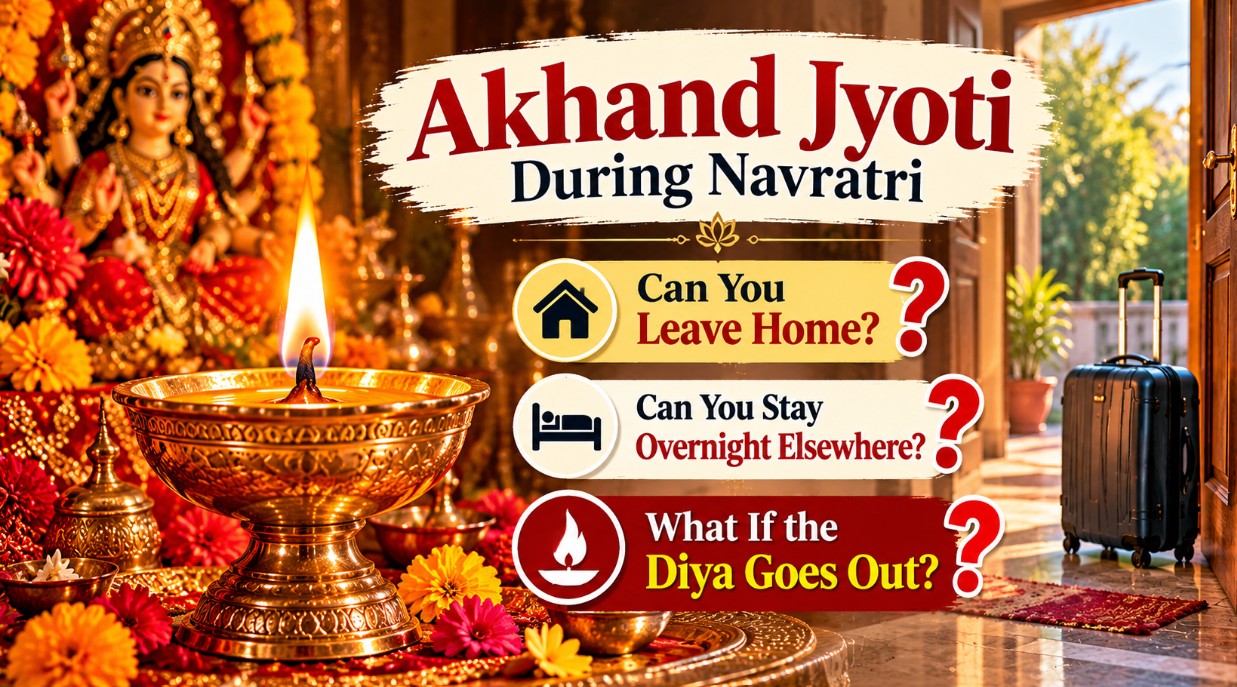
Navratri is one of the most sacred Hindu festivals, celebrated with devotion, fasting, prayers, and the worship of Goddess Durga in her nine divine forms. During these auspicious nine days, many Hindu families follow the tradition of lighting an Akhand Jyoti, a sacred lamp that is traditionally kept burning continuously throughout the festival.
The uninterrupted flame represents faith, spiritual awareness, dedication, and devotion to Maa Durga.
However, this beautiful religious tradition raises several practical and spiritual questions.
Can we leave our house when Akhand Jyoti is burning? Is it necessary for someone to remain at home throughout Navratri? Can we stay overnight at a relative’s house? What if the entire family needs to travel? And most importantly, what happens if Akhand Jyoti accidentally goes out?
Many devotees worry that accidentally breaking the continuity of the sacred flame may bring bad luck or displease Goddess Durga.
In this article, we explore the spiritual meaning of Akhand Jyoti, commonly followed Navratri traditions, different family customs, and important fire-safety precautions.
What Is Akhand Jyoti During Navratri?
The term Akhand Jyoti comes from two Sanskrit-derived words:
- Akhand means uninterrupted, continuous, or unbroken.
- Jyoti means light or flame.
Therefore, Akhand Jyoti literally means an uninterrupted flame.
During Navratri, devotees traditionally light a diya filled with ghee or oil in front of Goddess Durga. In households observing this custom, the lamp is intended to remain illuminated throughout the period of worship, often for nine days and nights.
The ritual may begin with Ghatasthapana or Kalash Sthapana, when devotees formally establish the sacred pot and begin their Navratri prayers.
Some families observe Akhand Jyoti every year, while others light it during particular religious occasions or after making a special spiritual commitment known as a Sankalp.
The ritual is associated with discipline, continuous prayer, and the devotee’s commitment to Goddess Durga.
Why Is Akhand Jyoti Considered Important?
In Hindu spirituality, light holds deep symbolic significance.
A burning lamp is traditionally associated with wisdom, purity, awareness, and the removal of ignorance.
Just as a flame illuminates a dark room, spiritual knowledge is believed to guide individuals away from ignorance and negativity.
The uninterrupted flame of Akhand Jyoti can symbolize several important qualities.
1. Continuous Devotion to Goddess Durga
The sacred flame represents a devotee’s intention to remain spiritually connected with the Divine Mother throughout the worship period.
2. Light Over Darkness
Light is often understood as a symbol of knowledge, while darkness represents ignorance.
Keeping a diya illuminated becomes a reminder to cultivate awareness and positive thinking.
3. Spiritual Discipline
Observing Akhand Jyoti traditionally involves regular attention to the lamp, cleanliness, prayers, and a commitment to the chosen ritual.
This discipline can encourage mindfulness and dedication.
4. Faith and Inner Strength
For many devotees, the flame represents hope and inner strength during challenging circumstances.
5. A Peaceful Prayer Environment
The presence of a diya during worship may help create a calm and devotional atmosphere.
These meanings are based on spiritual interpretations and religious beliefs rather than scientifically established supernatural effects.
Can You Leave Home When Akhand Jyoti Is Burning?
This is one of the most frequently discussed questions about Akhand Jyoti during Navratri.
The answer depends on family traditions, the nature of the religious commitment, and whether the burning lamp can be kept safe.
In many Hindu households, devotees believe that someone should remain present in the home when Akhand Jyoti has been established.
This custom is associated with maintaining the sanctity of the worship and ensuring that the flame receives proper attention.
For example, the traditional guidance published by The Art of Living specifically advises against leaving an Akhand Jyoti unattended.
However, this does not establish a universal religious prohibition preventing every family member from stepping outside the house during Navratri.
Different families and religious communities may follow different customs.
Can You Go to Work or the Market?
Suppose you have lit Akhand Jyoti at home but need to go to the office, buy groceries, attend an appointment, or complete an important responsibility.
Leaving the house for these reasons should not automatically be interpreted as a spiritual mistake.
Some families arrange for other adult members to remain at home and attend to the worship.
Nevertheless, a diya is an open flame. Having someone somewhere in the house does not eliminate the danger of a fire.
A burning lamp requires appropriate, active supervision, and it should never be left unattended.
If supervision cannot be maintained, extinguishing the flame safely is more important than preserving ritual continuity. Families may consult their religious guide about how to adapt the observance.
Can You Stay Overnight Somewhere Else During Akhand Jyoti?
Another common question is whether devotees may sleep at another person’s house while Akhand Jyoti is burning at home.
This may arise when someone wishes to visit their parents, stay with relatives, travel for work, or attend a family function.
What Do Traditional Beliefs Say?
Some families believe that the person undertaking the Akhand Jyoti Sankalp should remain at home throughout Navratri.
Others believe that family members can share the responsibility of caring for the sacred lamp and conducting daily prayers.
There is no single uniform household practice followed by all Hindus.
What If Another Family Member Is at Home?
In certain family traditions, a person may be permitted to stay elsewhere when other family members continue the worship.
However, religious permission and fire safety are separate matters.
Even when other people are present, a continuously burning diya is not safe to leave without supervision, particularly when everyone is asleep.
What If the Whole Family Must Stay Away Overnight?
If the entire family needs to spend a night elsewhere, leaving an oil or ghee lamp burning in an empty house creates a fire hazard.
The safest action is to extinguish the flame before leaving.
Devotees concerned about their Sankalp can discuss an appropriate alternative prayer or ritual procedure with their family priest.
Important: No religious observance should require a family to expose its members, neighbours, or property to preventable fire danger.
Is It Necessary for Someone to Remain Home for All Nine Days?
In homes where Akhand Jyoti is a long-standing family tradition, it is common for relatives to plan their routines around the worship.
Some families distribute responsibilities among adults so that prayers and other religious practices can continue throughout Navratri.
The reasons behind this custom may include maintaining religious discipline, attending to the sacred lamp, and preserving an atmosphere of devotion.
However, remaining inside the house continuously is not necessarily a universal requirement for everyone who celebrates Navratri.
It is also important to remember that simply having someone at home does not make an unattended flame safe.
If continuous adult supervision is impractical, the family should consider a safer form of worship rather than leaving an open flame burning.
What Happens If Akhand Jyoti Goes Out Accidentally?
Many devotees feel worried when an Akhand Jyoti unexpectedly stops burning.
Some fear that it may be a sign of bad luck, a broken religious vow, or the displeasure of Goddess Durga.
However, an oil lamp can go out for entirely ordinary physical reasons.
These include:
- Insufficient ghee or oil
- A shortened or damaged cotton wick
- A sudden movement of air
- Incorrect wick positioning
- Problems with the lamp or fuel
The flame depends on fuel, oxygen, and suitable conditions for combustion.
Therefore, an accidentally extinguished lamp does not demonstrate that something unfortunate is going to happen.
Is It an Inauspicious Sign?
Some traditional interpretations attach spiritual significance to the continuity of Akhand Jyoti.
Nevertheless, there is no reliable basis for predicting misfortune merely because the diya has gone out.
Religious practice should encourage devotion and peace rather than constant fear.
What Should You Do If the Flame Goes Out?
In many families, the customary response is to offer a prayer to Goddess Durga and relight the lamp.
The procedure may involve checking the wick, replenishing the fuel, and making a respectful prayer for forgiveness if the interruption was accidental.
Such guidance is also described in discussions of Navratri customs published during the 2026 festival.
Before relighting any diya, check for spilled fuel, damaged containers, combustible decorations, or other safety hazards.
If the lamp cannot be used safely, do not relight it.
The particular religious procedure should follow the family’s own tradition or the advice of a trusted priest.
Does Goddess Durga Become Angry If Akhand Jyoti Goes Out?
There is no way to establish that an accidentally extinguished flame means Goddess Durga is angry.
Religious beliefs and rituals are interpreted differently across Hindu families and spiritual traditions.
Many devotees understand worship as an expression of sincerity, gratitude, discipline, and love for the Divine Mother.
An unintentional mistake in a ritual need not become a source of anxiety.
A more constructive response is to remain calm, understand why the flame went out, and continue worship in a manner consistent with personal beliefs and safety.
The central message is simple: devotion should not depend on fear of an accidental event.
Can You Light Akhand Jyoti Again After It Goes Out?
In several family and regional traditions, devotees relight the lamp after an accidental interruption.
Some families offer a brief prayer or follow a particular method recommended by their priest.
Others may have different rules concerning a formal Sankalp.
Accordingly, there is no universally applicable procedure for every household.
If a family wishes to continue the ritual, it should first ensure that the lamp and surrounding area are safe.
Relighting should take place only when the flame can be supervised appropriately.
Can Akhand Jyoti Be Lit for Fewer Than Nine Days?
Not every Navratri devotee follows the same ritual.
Some households light a regular diya during morning and evening prayers rather than maintaining an uninterrupted flame.
Others observe Akhand Jyoti only for a specific religious commitment.
The important distinction is between a regular prayer lamp and an Akhand Jyoti that is traditionally associated with continuous burning.
If maintaining a nine-day flame is not practical or safe, devotees may choose a regular supervised prayer lamp instead.
Anyone who has already undertaken a formal Sankalp may consult their religious guide about an appropriate adjustment.
Which Is Better for Akhand Jyoti: Ghee or Oil?
Both ghee and oil are used in Hindu worship, although preferences vary by region, family tradition, and ritual.
Ghee Diya
Ghee is traditionally valued in many religious ceremonies. Some devotees prefer it for worship because of its ritual associations with purity and auspiciousness.
Oil Diya
Oil lamps are also common during Navratri. Mustard oil and sesame oil are used in certain household and temple traditions.
Neither choice removes the risks associated with an open flame.
The lamp must be stable, the fuel handled carefully, and the surrounding area kept free of combustible materials.
Important Fire Safety Rules for Akhand Jyoti at Home
Fire safety is especially important when a diya is kept near religious decorations.
Navratri altars are often decorated with fabric, flower garlands, paper ornaments, and other materials that can catch fire.
The National Fire Protection Association advises that open-flame candles should never be left unattended and should be extinguished before leaving or sleeping. These principles are also relevant to traditional oil and ghee lamps.
Follow these important precautions.
1. Use a Stable, Heat-Resistant Base
Place the diya on a strong, level, non-combustible surface.
Avoid unstable tables, narrow shelves, or places where the lamp can be knocked over.
2. Keep the Flame Away From Decorations
Maintain a clear distance between the flame and curtains, clothing, religious cloth, dried flowers, and paper decorations.
3. Keep Children and Pets Away
A burning diya can cause serious burns or start a fire if accidentally touched or knocked over.
4. Never Leave a Burning Diya Unattended
Do not leave home while the flame is burning without supervision.
Having security cameras, smoke detectors, or someone in another room does not replace appropriate attention to an open flame.
5. Do Not Leave the Lamp Burning While Everyone Sleeps
A continuously burning diya can become dangerous during the night, especially if everyone is asleep.
If active supervision cannot be maintained, extinguish the lamp safely.
6. Handle Fuel Carefully
Avoid spilling oil or ghee near a lit flame.
Do not attempt unsafe adjustments to a burning lamp.
7. Consider Safer Alternatives
When maintaining an open flame is impractical, a supervised diya for daily worship or a flameless electric lamp can provide a safer alternative.
A flameless lamp is not necessarily a ritual substitute for Akhand Jyoti under every religious tradition, so families should make that choice according to their beliefs.
What If You Have an Emergency During Navratri?
Emergencies cannot always be predicted.
A medical situation, family responsibility, unexpected journey, or other urgent matter may require everyone to leave the house.
In such situations, safety and immediate responsibilities should come first.
If nobody can supervise an open flame, extinguish it before leaving.
Do not delay essential medical care or other urgent action because of fear that interrupting Akhand Jyoti will bring misfortune.
If you wish to continue your religious commitment later, seek advice from a knowledgeable family elder or priest.
Faith and practical responsibility can coexist.
Common Myths and Facts About Akhand Jyoti
| Common Belief | A More Balanced Understanding |
|---|---|
| Nobody can leave the house during Akhand Jyoti. | Some families follow this custom, but it is not a universal prohibition on every person leaving home. |
| You cannot sleep at a relative’s house during Navratri. | Practices differ according to household traditions and religious commitments. |
| An extinguished diya always brings bad luck. | A flame can go out for ordinary physical reasons; it does not establish future misfortune. |
| Goddess Durga becomes angry if the flame accidentally goes out. | This cannot be established from the event itself. Devotees may respond with prayer rather than fear. |
| It is safe to leave a diya burning as long as someone is inside the house. | A burning flame still requires active attention and appropriate fire precautions. |
| Every Hindu family must maintain Akhand Jyoti for nine days. | Many families instead follow regular daily diya and prayer traditions. |
Frequently Asked Questions About Akhand Jyoti
1. Can we lock the house while Akhand Jyoti is burning?
You should never lock an empty house and leave an oil or ghee diya burning inside. An unattended open flame presents a serious fire risk.
If the family must leave, extinguish the lamp safely and consult your religious guide about the ritual implications.
2. Can husband and wife both go outside during Akhand Jyoti?
Religious expectations vary between families. Both may need to leave for essential responsibilities, but neither should leave a burning lamp unattended. If safe supervision is unavailable, extinguish the flame.
3. Can we go to the office during Navratri Akhand Jyoti?
Going to work is not universally prohibited by Navratri observance. Follow your family’s religious practices while ensuring that no burning lamp is left unattended.
4. Can we spend the night at our parents’ or relatives’ house?
Some households discourage overnight stays during a formal Akhand Jyoti Sankalp, while others follow different customs. If staying elsewhere means leaving the house empty, the diya must be safely extinguished before departure.
5. What happens if Akhand Jyoti goes out at night?
The flame may have gone out because of insufficient fuel, wick problems, or airflow. There is no reason to assume that the event predicts misfortune. If the lamp is safe, families may follow their customary prayer and relighting procedure when supervision is available.
6. Can we relight Akhand Jyoti with a new wick?
Some traditions permit replacing the wick and relighting the diya after an accidental interruption. Specific practices vary, so follow your household custom or consult your priest.
7. Is Akhand Jyoti compulsory during Navratri?
No. Many Hindu households observe Navratri through prayers, fasting, aarti, devotional reading, and regular diya lighting without maintaining a continuous flame.
8. Is Akhand Jyoti necessary for receiving the blessings of Maa Durga?
The importance of any specific ritual depends on individual beliefs and traditions. It would not be appropriate to claim that divine blessings depend exclusively on maintaining a continuously burning lamp.
9. Can we use an electric diya instead of Akhand Jyoti?
An electric diya is a safer decorative or devotional light source because it does not use an open flame. However, it may not be considered ritually equivalent to Akhand Jyoti in every religious tradition.
10. What should we do if the family has to travel unexpectedly?
Prioritize safety, extinguish any burning lamp before leaving, and consult a trusted religious guide if you wish to formally adjust or conclude your Sankalp.
The Deeper Spiritual Message of Akhand Jyoti
Akhand Jyoti is much more than the physical act of lighting a lamp.
For many devotees, it represents an enduring commitment to faith, inner awareness, and spiritual discipline.
Its symbolic message can be understood through everyday life.
Just as a flame requires fuel and protection to continue burning, our values and relationships require continuous care.
Just as light dispels darkness, knowledge can help us overcome ignorance.
And just as a devotee returns to prayer with sincerity, we can return to patience and kindness even when life does not unfold as planned.
The beauty of a religious tradition lies not only in observing its procedures but also in understanding the values it seeks to inspire.
Conclusion: Faith, Tradition, and Safety Should Go Together
Keeping Akhand Jyoti during Navratri is a meaningful devotional practice followed by many Hindu families.
However, questions about leaving home, travelling, staying elsewhere overnight, or accidentally extinguishing the diya should be approached with understanding rather than unnecessary fear.
Some families maintain specific customs concerning the presence of household members and the continuity of worship. These traditions deserve respect, but they should not be presented as universal obligations followed by every Hindu.
Likewise, an accidentally extinguished flame should not automatically be treated as a warning of future misfortune.
Above all, an open flame must never be allowed to endanger people or property.
The true spirit of devotion can be honoured through sincerity, responsibility, compassion, and respect for both religious traditions and human safety.
Omilights youtube video on Navratri Akhand Jot precautions, care and significance
Related Posts


About The Author

Omilights
Omilights love to post every informative piece of information on the website. We want to connect the world by way of reading and sharing information, that is why we have not restricted our postings to one or more categories. We will post whatever would be useful and happening round the world, and also hoping for your valuable feedback and comments.