Why Does a Person Stammer While Speaking but Sing Smoothly?
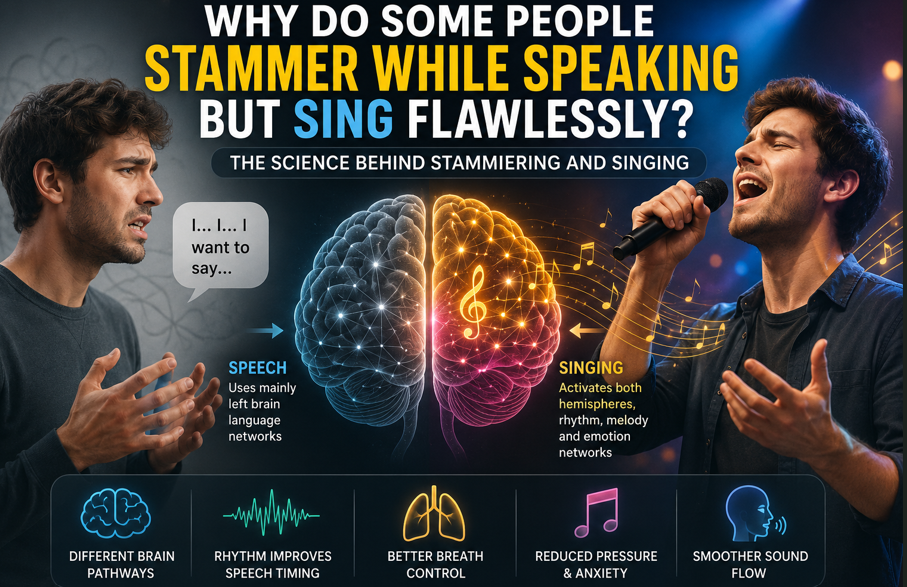
This is one of the most fascinating mysteries of the human brain.
Many people who struggle to speak a simple sentence fluently can suddenly sing an entire song perfectly — without getting stuck on words, repeating sounds, or experiencing blocks.
At first glance, this feels unbelievable.
But science has a very logical explanation for it.
And the answer lies in how the brain processes speech, rhythm, music, emotion, and motor coordination.
First Understand: What Is Stammering?
Stuttering — also called stammering — is a speech fluency disorder where a person may:
- Repeat sounds or syllables
- Stretch words
- Get stuck while speaking
- Experience sudden pauses or blocks
- Feel tension while trying to talk
Example:
- “M-m-m-my name is…”
- “I waaaant…”
- Complete speech block before speaking
Importantly:
Stammering Is NOT a Sign of Low Intelligence
Many brilliant people have stammered, including:
- Bruce Willis
- Joe Biden
- Ed Sheeran
- Hrithik Roshan
Stammering has nothing to do with intelligence, capability, creativity, or success.
Then Why Does Singing Become Fluent?
Because Singing and Normal Speaking Use the Brain Differently
This is the biggest reason.
Scientists discovered that:
Normal speaking mainly depends on:
- Fast language processing
- Word selection
- Real-time sentence creation
- Instant coordination of tongue, lips, throat, and breathing
This creates pressure on the brain’s speech system.
But singing changes the entire mechanism.
Singing uses:
- Rhythm
- Melody
- Predictable patterns
- Controlled breathing
- Musical timing
- Different neural pathways
As a result, the brain experiences less speech disruption.
Scientific Reason #1: Singing Activates Different Brain Regions
Speaking is strongly connected with the brain’s left hemisphere, especially areas responsible for language.
But singing activates:
- Both hemispheres
- Emotional centers
- Rhythm-processing regions
- Musical memory systems
This means singing creates an alternative route for speech production.
Researchers found that many people who stammer show smoother communication when musical pathways become active.
Scientific Reason #2: Rhythm Helps the Brain Synchronize Speech
One major feature of singing is rhythm.
When speaking normally:
- Speech timing changes constantly
- The brain must rapidly coordinate sounds
But songs already have:
- Fixed tempo
- Predictable syllables
- Structured timing
This rhythmic pattern acts like a guide for the brain.
It reduces timing errors that often trigger stammering.
That is why many speech therapists use:
- Rhythmic speaking
- Metronomes
- Tapping exercises
- Singing therapy
to improve fluency.
Scientific Reason #3: Singing Slows Down Speech Production
People usually speak quickly in daily life.
Fast speech increases:
- Pressure
- Anxiety
- Motor coordination errors
But singing naturally slows speech.
When singing:
- Words are stretched
- Breathing becomes controlled
- Sound transitions become smoother
This gives the brain more time to coordinate speech muscles.
As a result:
- Blocks reduce
- Repetitions reduce
- Fluency improves
Scientific Reason #4: Singing Uses Memorized Words Instead of Spontaneous Speech
Normal conversation requires:
- Thinking instantly
- Choosing words quickly
- Forming sentences in real time
This increases cognitive load.
But songs are already memorized.
The brain does not need to:
- Search for words
- Build new sentences
- Fear “what to say next”
This reduces mental pressure and improves fluency.
Scientific Reason #5: Breathing Becomes More Stable During Singing


Breathing plays a huge role in stammering.
Many people who stammer:
- Hold breath unconsciously
- Speak with shallow breathing
- Experience tension in throat muscles
But singing teaches:
- Deep breathing
- Controlled airflow
- Diaphragm support
- Smooth voice release
This stabilizes speech production.
Scientific Reason #6: Reduced Fear and Social Pressure
Many people stammer more in situations involving:
- Judgment
- Interviews
- Public speaking
- Phone calls
- Authority figures
Because anxiety worsens stammering.
But while singing:
- The brain focuses on melody
- Emotional expression increases
- Fear reduces
- Self-consciousness decreases
The person stops over-monitoring speech.
And fluency improves naturally.
Scientific Reason #7: Continuous Sound Flow Prevents Blocks
In normal speech:
- Words start and stop rapidly
These sudden starts often trigger blocks.
But singing creates:
- Continuous airflow
- Smooth transitions between sounds
This reduces speech interruptions.
That is why many people who stammer also speak more fluently when:
- Whispering
- Speaking rhythmically
- Talking in chorus
- Reciting poetry
Is Stammering a Disease?
Scientifically, stammering is considered a speech fluency disorder, not a disease like fever or infection.
It is usually linked with:
- Genetics
- Brain timing differences
- Motor coordination patterns
- Emotional responses
- Speech processing mechanisms
And importantly:
A Person Who Stammers Is Fully Capable
Stammering does NOT mean:
- Weak intelligence
- Low confidence
- Lack of talent
- Lack of knowledge
Sometimes a highly intelligent and creative brain processes thoughts faster than speech output.
Can Singing Help Reduce Stammering?
Yes — To Some Extent
Singing is often used in:
- Speech therapy
- Music therapy
- Fluency training
It may help improve:
- Breath control
- Confidence
- Rhythm coordination
- Speech smoothness
However:
Singing Is Not a Guaranteed “Cure”
Every person’s stammering pattern is different.
Some people experience huge improvement.
Others experience moderate improvement.
Professional speech therapy remains important.
Why Some Experienced and Talented People Still Stammer
This is important to understand.
A person may:
- Have deep knowledge
- Be highly skilled
- Be technically brilliant
- Be emotionally intelligent
yet still stammer.
Speech fluency and capability are completely different things.
Sometimes society incorrectly judges communication speed as intelligence.
But many exceptional leaders, creators, engineers, actors, singers, and innovators have dealt with stammering.
The inability to speak fluently under pressure does not reduce a person’s worth or talent.
The Psychology Behind It
Many people who stammer develop:
- Fear of interruption
- Anticipation anxiety
- Overthinking before speaking
Ironically, the harder they try to speak perfectly, the worse the stammer becomes.
But during singing:
- The brain relaxes
- Speech becomes automatic
- Perfection pressure reduces
This creates smoother fluency.
What Researchers Believe Today
Modern neuroscience suggests stammering may involve:
- Timing differences in speech networks
- Auditory feedback processing
- Motor planning coordination
- Neural communication irregularities
But scientists still continue researching the exact causes.
One thing is clear:
Music has a powerful effect on speech networks in the brain.
And that is why singing can temporarily bypass many stammering difficulties.
Final Conclusion
The reason some people stammer while speaking but sing flawlessly is deeply connected to:
- Brain function
- Rhythm
- Breathing
- Neural pathways
- Emotional state
- Speech timing
Singing changes how the brain produces language.
It introduces:
- Rhythm
- Predictability
- Melody
- Controlled breathing
- Reduced anxiety
Together, these factors help many people speak fluently while singing.
And most importantly:
Stammering does not define intelligence, success, talent, or human value.
A person may struggle with speech and still possess extraordinary creativity, knowledge, leadership, and capability.
Sometimes the voice hesitates — but the mind behind it can still be brilliant.
Disclaimer
This article is intended for educational and informational purposes only. It is not meant to diagnose, treat, cure, or replace professional medical or psychological advice.
Stuttering (stammering) varies from person to person. The scientific explanations shared in this article are based on general research related to speech fluency, neuroscience, music, and communication disorders. Individual experiences may differ.
If stammering is affecting daily communication, confidence, emotional well-being, education, or professional life, it is recommended to consult a qualified:
- Speech-language pathologist (SLP)
- Neurologist
- Mental health professional
Singing, rhythm exercises, and breathing techniques may help improve fluency for some individuals, but they should not be considered a guaranteed cure.
This content does not intend to label, judge, or diminish any individual. Stammering is not a measure of intelligence, talent, capability, or personal worth.
Related Posts


About The Author

Omilights
Omilights love to post every informative piece of information on the website. We want to connect the world by way of reading and sharing information, that is why we have not restricted our postings to one or more categories. We will post whatever would be useful and happening round the world, and also hoping for your valuable feedback and comments.